Throttled to 1996: A Week Living at Dial-Up Speed So You Don't Have To
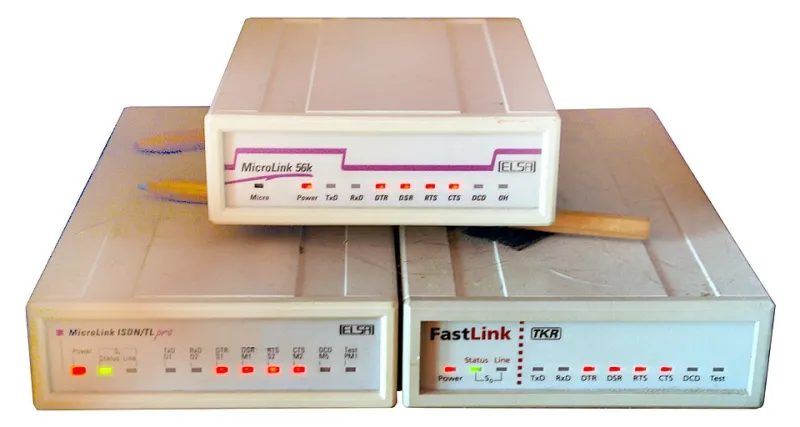
Photo: File:Elsa Modems IMGP0424.JPG: Johann H. Addicks - [email protected] derivative work: Pittigrilli, GFDL 1.2, via Wikimedia Commons
Somewhere in a closet, my grandparents still have a cardboard box labeled 'COMPUTER STUFF' containing a US Robotics modem, a coiled phone cord, and a printout of AOL billing rates. I've thought about that box a lot lately, mostly while watching a 4K hero video buffer on a 900-megabit fiber connection that somehow still feels slow.
So I ran an experiment. Using a router with traffic shaping, I throttled my entire household to 56 kilobits per second — genuine dial-up speed, no cheating — for one week. The goal wasn't nostalgia. The goal was to find out what modern software actually spends its bandwidth on when you take abundance away.
The results were humbling, occasionally rage-inducing, and — for one week at least — made my grandparents look like prophets.
The Setup: A Time Machine Made of QoS Rules
Dial-up in its heyday topped out around 53 kilobits per second in real-world conditions, thanks to FCC power limits on phone lines. I set my traffic shaper to 56 Kbps down, 33.6 up (because even in 1998, upstream was always the sad sibling), and added roughly 150ms of latency for authenticity.
I did not reconnect an actual modem. My marriage has limits.
The rules were simple: the whole network runs at dial-up speed all week. One exception per device per day — a 'phone line' allowance, like letting a family member make a call while someone's online.
What Broke First: Everything, But in a Revealing Order
Day one killed my smart home. The smart TV spent its first hour on the network silently pulling updates and telemetry before anyone even touched the remote. When my wife tried to open Netflix, the app spent four minutes on its splash screen. The TV itself, it turns out, was downloading ad configuration data. The show didn't load. The ads did.
That became the pattern for the week: the stuff you asked for struggled, while the stuff nobody asked for arrived right on time.
What the Numbers Said
I ran a packet sniffer on the router for the week and categorized the traffic. Here's the rough breakdown of our 56 Kbps budget:
- Telemetry and analytics: ~30% of all traffic. Every app on every device phoning home about crashes, sessions, and things we'd never learn from.
- Ads and trackers: ~25%. On the web, this was brutal. A recipe site I visited served roughly 2 megabytes of scripts and ad calls before the actual recipe — which, at dial-up speed, is about five minutes of loading a lemon bar list.
- Auto-playing video and images: ~20%. Sites I never would have described as 'video sites' still tried to push footage at me.
- Actual content: maybe 15%. The text I came for was a rounding error.
The most damning artifact of the week: a plain HTML page of a recipe, saved by a reader-mode extension, loaded in under two seconds. The same recipe on the live site took four minutes. Identical information. Two-hundred-fold difference in weight.
The Web Is Not Slow. Your Web Is Heavy.
Here's the thing nobody says out loud: the web didn't get slower because the physics got harder. The median web page in 2025 weighs more than the entire install disc of Windows 98, and almost none of that weight is the thing you clicked for.
At dial-up speed, you experience this weight as time. On fiber, you experience it as your ISP's data cap quietly filling up, your phone's battery draining, and a vague sense that everything online feels 'busy' now. The bloat doesn't disappear at high speeds — it just becomes invisible.
What the Family Actually Missed
My wife missed Spotify (audio streaming at low bitrate is one of the few things that sort of works at 56K — dial-up-era ingenuity, meet modern compression). My kid missed YouTube, obviously, and survived on downloaded videos I synced during my daily 'phone line' exception.
I missed... honestly, less than I expected. Email worked. RSS readers worked. Text-based sites were fine. Wikipedia was fine. The parts of the internet built on the assumption that reading is the point held up beautifully. The parts built on the assumption that you're always watching something fell apart instantly.
By day five, I noticed something else: I was browsing differently. Fewer tabs, more intention. You don't open eight tabs at 56K. You open one, you read it, you close it. It was the closest I've come to the focused internet of my childhood, and I got there without a single productivity app.
The Verdict: Keep the Fiber, Lose the Entitlement
I'm not going to tell you dial-up was better. It wasn't. Waiting three minutes for a JPEG of a dancing baby is not a lifestyle anyone should romanticize.
But the week taught me something worth keeping: bandwidth abundance didn't make the web better. It made it lazier. Developers stopped caring about payload size because nobody complained. Ad tech multiplied because the meter wasn't running. Every 'small' script is small because the cost got pushed onto someone else's cap, battery, or patience.
The throttle is off now, and the fiber is glorious. But I kept one habit: reader mode by default, telemetry blocked at the DNS level, and a standing suspicion of any app that needs to talk to eleven servers before it shows me a lemon bar recipe.
My grandparents' box of computer stuff is still in the closet. The modem works, allegedly. Some weekends I'm tempted.
Not to use it. Just to remember what the web sounded like when it had to earn every kilobit.